
Business
Lori Huang survived a near-fatal car crash
By Marcus Chen
Advertisement · Why this ad?
Katherine oversees editorial operations across all six brands. Before joining The Meridan Group, she spent 14 years at the Minneapolis Star Tribune, where she led the metro desk through its digital transformation. She holds a Master's in Journalism from Northwestern's Medill School.
More from Katherine →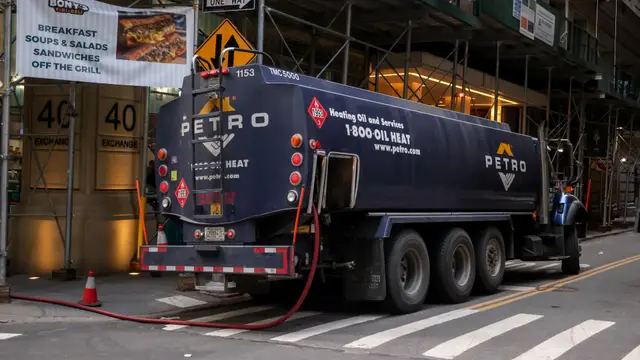
Heating oil prices averaged $5.91 per gallon as of Nov. 2, a 59% jump from a year earlier, according to the U.S. Energy Information Administration.
In Maine, where roughly 50% of the homes rely primarily on heating oil, the jump "is crushing folks" who already were struggling due to the high cost of living, said Jason Parent, CEO of AVEC Community Action, a nonprofit agency in Presque Isle, Maine.
While the average benefit through a heating assistance program is higher this year, it won't go as far for households that need heating oil, Parent said.
The Trump administration has released some reserve barrels in an effort to bring down prices, and some congressional lawmakers are calling for additional funding for heating assistance.
An oil tank stands outside a residence at a mobile home cooperative in Veazie, Maine, Oct. 31, 2026.
Winter heating bills can strain household budgets. This year, a spike in heating oil prices could make the season especially difficult for households that depend on the fuel and have little financial wiggle room.
The national average price of heating oil was roughly $5.91 a gallon as of Nov. 9, up about $2.19, or 59%, from a year earlier, according to the U.S. Energy Information Administration.
In Maine, the average price per gallon is roughly $5.83, up about $2.49 from a year earlier, or about 75%. The state is among those whose residents may feel the price rise acutely — about 50% of homes there use heating oil.
The jump "is crushing folks," said Jason Parent, CEO of AVEC Community Action, a nonprofit agency based in Presque Isle, Maine, that provides heating assistance and other social services in three of the state's 16 counties. Many residents face immediate crises, he said, such as empty fuel tanks or reliance on unsafe heating sources.
"My fear is that there are households out there who have secondary fuel sources like wood stoves, pellet stoves and other things that are no longer operating and functioning in a safe way," Parent said.
IRS announces 2027 401(k) contribution limits, raises savings cap Why Nvidia stock drop isn't a big deal for many ETF, mutual fund investors Social Security could pay benefits until 2059 if payroll kept pace with GDP: AARP CNBC's Financial Advisor 100: Best financial advisors, top firms for 2026 ranked CNBC Elite Advisors: Top ultra-high net worth wealth management firms for 2026 The price surge comes on the heels of years of high overall inflation that has already squeezed household budgets, he said.
"The cost of living has made it impossible for households who had been figuring out how to get by without [financial help]," Parent said.
The price spike comes amid a tight global market for refined fuels, a category that includes heating oil and diesel. Supply shocks tied to the Iran war and the Russia-Ukraine war, low inventories and limited refining capacity have constrained supplies and added upward pressure on fuel prices, according to recent research from the Federal Reserve Bank of Kansas City.
EIA predicts that a warmer winter in the Northeast will reduce consumption, helping to offset higher prices. In October, the agency forecast that the average household using heating oil will spend $2,115 from November through March, about 21% more than last year.
A heating oil truck near the New York Stock Exchange in New York, March 30, 2026.
Meanwhile, homes primarily heated with natural gas are expected to spend an average of $640 this winter, down 9%, while those using propane are forecast to spend an average of $1,246, down 3%, according to the EIA's October forecast. Households using electricity for heating are expected to spend an average of $1,196, up 4% from a year ago. These are national figures.
Roughly 4.1 million U.S. households use heating oil as their primary means of heating their homes, according to the EIA. Most of them — close to 3.4 million — are located in the Northeast.
Unlike electricity or natural gas, heating oil is delivered in large quantities. Payment terms vary, but some dealers require a minimum delivery or charge extra for smaller orders. In Maine, for example, ordering at least 100 gallons for a standard 275-gallon tank can avoid a surcharge, according to the state attorney general's office. At current prices, that 100 gallons would cost about $600 — a tall order for some households.
AVEC's Home Energy Assistance Program, or HEAP, provides financial assistance to qualifying households, based primarily on income and the number of people living in the home. Funding originates with the federal Low Income Home Energy Assistance Program, or LIHEAP, which is run by the U.S. Health and Human Services Department and overseen by state agencies, often working with local organizations such as AVEC.
Maine and tribal grantees in the state received about $38 million from LIHEAP in October, according to a press release from outgoing Republican Sen. Susan Collins. AVEC administers about $4 million of that through HEAP, Parent said. AVEC also gets donations from community fundraising to help residents cover heating costs.
A component of HEAP is the Energy Crisis Intervention Program, which serves qualifying families who face an energy crisis, such as a potential electric shutoff or an empty oil tank and no financial means to replenish the supply.
AVEC began taking calls for that program on Nov. 2, Parent said.
"In the first hour alone, there were 150 voicemail messages on our emergency fuel line," Parent said. "People were in crisis before the program opened up."
Charitable donations help residents in crisis
Catherine Lafleche of Hersey, Maine, describes AVEC as a lifeline.
The 65-year-old is guardian to two grandchildren, ages 11 and 6, and is living mostly on about $1,100 in monthly Social Security benefits and state guardianship assistance, after shattering her upper-arm bone in a fall in April. Her injury required reverse shoulder replacement surgery, from which she continues to recover. Before that fall, she had worked as a substitute teacher and bookkeeper.
"I'm $6,000 short of income at this point in the year," Lafleche said.
Hersey is in Maine's northernmost county, Aroostook, where January and February bring average high temperatures in the 20s and average lows in the single digits, based on National Oceanic and Atmospheric Administration data from 1991 to 2020 recorded at a Caribou Municipal Airport weather station. Last winter, the area experienced severe cold snaps, including on Jan. 24, when the high was minus 2 degrees Fahrenheit.
When the oil man came, I cried.
Lafleche applied to HEAP through AVEC in August, but a backlog meant potentially waiting until November for assistance. Unable to afford more fuel when it became chilly, she ran out of heating oil in early October and relied on a small wood stove to keep part of her house warm, burning Amazon boxes collected from other local residents because she didn't have enough firewood.
In late October, an AVEC representative called to say a charitable donation would cover 100 gallons of heating oil.
"When the oil man came, I cried," Lafleche said.
Benefits through AVEC don't stretch as far this year For residents in Maine who need help covering the cost to heat their homes and are seeking out help, "the need is outpacing the benefits," said Parent, of AVEC.
The average benefit through HEAP is about $750 per household thi
Seattle
Business
Saturday, November 14, 2026
6 min
By Marcus Chen

By Marcus Chen

By Katherine Langford

By Katherine Langford